


I always talked about moving across the world as a child.
One day, I thought I wanted to move to England, to study in the hallowed halls of Oxford. The next, I wanted to live in Paris, pursuing the life of a starving artist.
The dusty desert town I grew up in never really felt like home. More like a place I knew I had already outgrown, even at the age of five.
I packed my bags and moved to Germany when I was a teenager.
Everything there felt new and exciting. The language perhaps more than anything. It’s nuanced, its grammar like a formula that made more sense in my mind than any calculus ever had.
We take the ability to speak for granted. When speech is second nature, we don’t need to think about our words as much.
Everything shifts when you don’t understand.
I arrived in Germany barely knowing the basics. Every time I wanted to speak, I found myself grasping aimlessly at words.
There was no other choice than to become an observer. And there on the edge, I realized that most of what I wanted to say wasn’t even that important.
When I needed to say something? Every word was carefully examined, each phrase turned over a thousand times, everything superfluous discarded.
I resigned myself to imperfection each time I managed to piece together enough words to articulate what I wanted. I had to accept being messy. Because I had no other choice.
The first couple of months living abroad challenged me like I’d never been challenged before. I was frustrated. Exhausted.
At some point, something began to shift. I could suddenly understand what was being said. And while I still struggled to speak myself, it was as if I had found a lost key to a door that opened up exponential growth. As if I had opened my eyes for the first time.
Another few months, and I thought I was fully fluent, with a newfound confidence I hadn’t experienced since I’d arrived.
I may not have been fully aware of it at the time, but I was no longer that boy who left the desert. It wasn’t a sudden realization, but one that took a long time to develop, even if I had a subconscious sense of it.
Once I had entered the proverbial forest, there was no turning back.
As I’ve grown older, as I look back at that experience, I realize it was cathartic.
Initially, I thought that I had shed a part of myself there. But what if, instead, the experience simply revealed a part of myself that had been there all along?
I never felt like I fully belonged to one place. Even when the only place I knew was where I was growing up. And to this day, I’m not sure that I ever have.
But I was still young and didn’t know what I wanted from life. When I got a job that, frankly, I had no business getting—the temptation was too great.
So I moved to Berlin.
There, caught up in a world driven by taste and prestige, I built a successful career in media and publishing. I traveled the world. Dined at some of the finest restaurants. Stayed at some of the coolest hotels imaginable.
On the surface, my path was one of success. I had a thriving career and a network of culture-shaping tastemakers. But inside, I was deeply unhappy.
I worked ungodly hours. Partied through the weekend. Barely slept. Didn’t take care of my mind or my body.
My health pulled the emergency brake that time.
A life I had built around luxury came to a halt. A career I viewed as central to my identity, suddenly at an end. This time, my body made the choice for me.
I couldn’t do anything but recalibrate. To look closely at the life I was living. To think about the life I wanted.
I tried to resuscitate my former life a few times. But I came to realize that version of me was no more.
I left Berlin.
For the first time in a long time, I felt like I could breathe again.
I had nothing mapped out in front of me. No role to perform. I was starting over.
It’s been nearly a decade since then. Life has taken a different path.
That path started in San Francisco.
Life there is expensive. I needed a job.
So I got one in tech.
My first couple of weeks in the office were a whirlwind. Free lunches. Fancy swag. Wine and beer on tap.
It felt like I was at a daycare for adults, not a place of work.
But there were early signs it wasn’t all it seemed.
I was a contractor—not fully a part of the club. You see the same things everyone else does. But through a different lens. Because you’re forced to watch from the sidelines.
My experience coincided with the pandemic, and I remember clearly when the company announced “mental health days” for everyone to take some time for their wellbeing.
Everyone except for contractors.
Nevertheless, I stayed.
Eventually, I became a full-time salaried employee.
But if I’m being honest, I was underwhelmed. The view from inside wasn’t clearer. Just different.
I never imagined myself working corporate. Climbing a ladder.
And yet I got caught up in it anyway. The salary. The benefits. The structure. The security.
Perhaps it’s the security that mattered most in the years since. My career in tech coincided with the pandemic. Everything was in flux. Work seemed like a steady constant.
After two years on lockdown in San Francisco, I had the chance to move back to Europe through my job. So I packed up my life again and moved to London.
I could talk about London in a hundred posts. But all you need to know now is that it wasn’t a fit.
Working for a US company abroad comes with its own unique challenges. For me, it meant once again working late hours. No social life. And a city with a pace I couldn’t match.
I lasted less than two years there before I moved back to the States.
My job provided stability in a period of my life that was anything but.
It’s been a few years now since I made my way back. And for the first time since I left Berlin, it’s beginning to feel like roots are beginning to grow.
I no longer live in a big city, but instead the countryside. Life is at a different pace here.
Sure, cities are dynamic and energizing. I still love them.
But the space the country provides—both literal and metaphorical—has finally given me the room to think about what’s next.
In many ways, I feel like I’ve finally made it. I’ve chased success, titles, money. The approval of others. The American Dream.
But what if it’s not my dream?
What if that feeling I get when I’m sitting in another meeting, asking myself “Why am I even here?” isn’t a sign of failure, but a sign of succeeding at the wrong thing?
The hollowness I feel? The sense I’m putting on a mask every Monday morning, pretending to be someone I’m not? These are signals.
Signs of a golden façade with a crumbling foundation.
This isn’t the first time I’ve had this feeling. I had it as a boy in the desert. As an immigrant. As someone who hasn’t felt at home in any one place, perhaps ever.
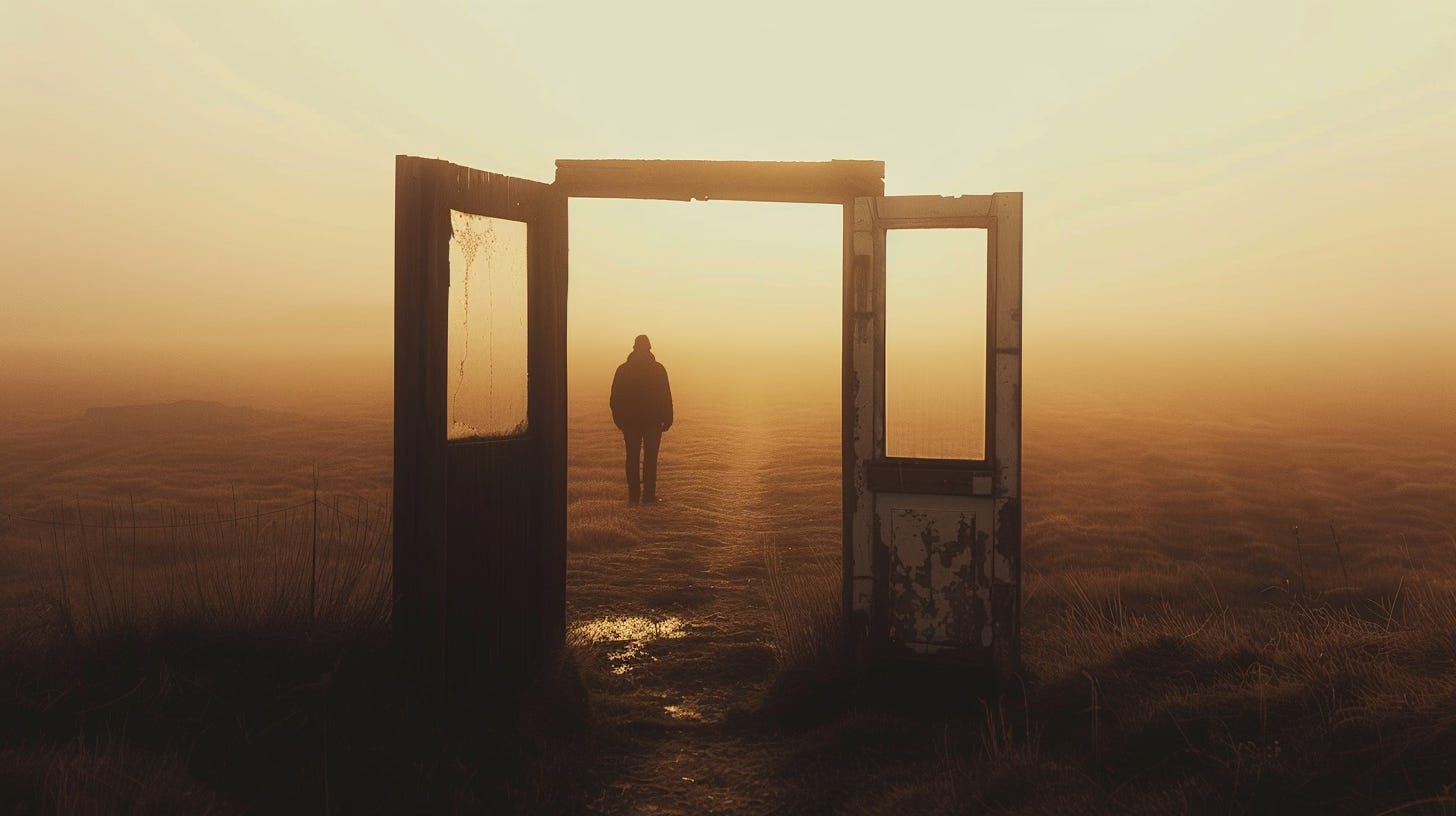
This space—the liminal threshold—is a place of uncertainty. But it’s also a vantage point.
So I’m taking a step into the unknown. A step toward the threshold. And I don’t know what’s on the other side.
I haven’t figured it out. I don’t know if I never will. Not knowing, I’ve come to realize, has always been the condition—not a problem waiting to be solved.
So if you’ve ever felt like you don’t belong, like the path you’re on isn’t quite yours—perhaps you’ll recognize something of yourself here.
Maybe we’ll figure things out together. But maybe we’ll just sit in the space in between.
It’s time to write a book. Just saying….🫶🏻
beautiful ❤️